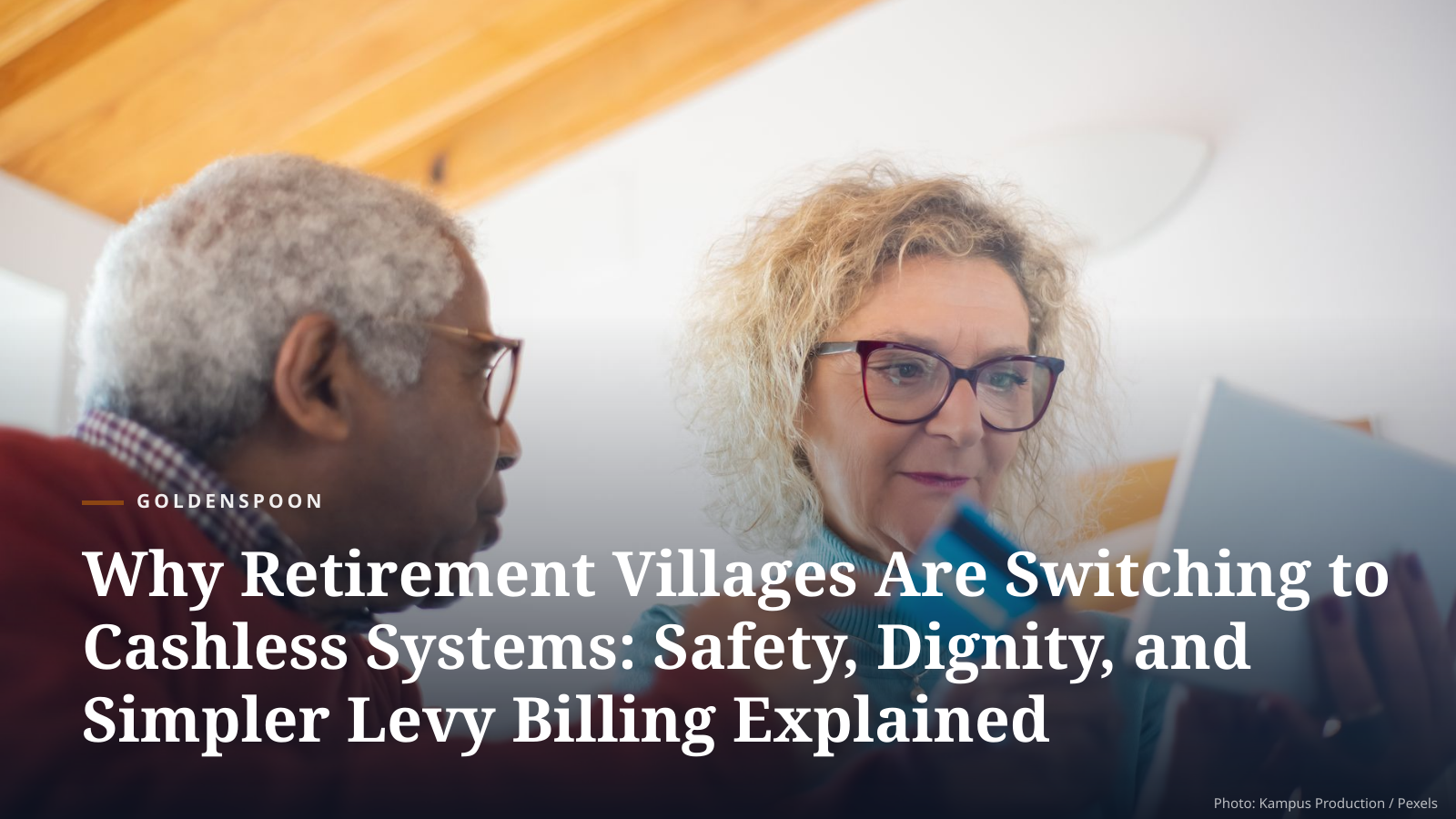
Why Retirement Villages Are Switching to Cashless Systems: Safety, Dignity, and Simpler Levy Billing Explained
Something quiet but meaningful is shifting across South African retirement villages. The cash tin on the kitchen counter is disappearing. The handwritten meal register is being retired. In its place, operators are choosing cashless systems that connect every meal order to a resident profile, a levy account, and a real-time kitchen ticket.
This is not a technology trend for its own sake. It is a practical response to problems that have cost villages money, caused stress for residents, and created unnecessary administrative burden for care teams. Let us walk through exactly why it is happening, and what it means for the people living and working in these homes.
The Real Problem With Cash in a Care Environment
Cash introduces risk in ways that compound quickly in a residential care setting. Residents carry notes and coins to the dining room. Money gets misplaced. Occasionally it goes missing. The resulting conversations are uncomfortable for everyone involved, and they erode the trust that a retirement village depends on.
Beyond loss, there is the administrative reality. Someone has to count the float. Someone has to reconcile daily takings against meals served. Someone has to chase residents who forgot their wallet. These are not trivial tasks. They pull care staff away from residents and create paperwork that serves no-one well.
Cashless payment solutions remove that entire layer of friction. When a resident selects a meal, the transaction is recorded automatically against their account. There is nothing to carry, nothing to lose, and nothing to reconcile at the end of a shift.
Safety That Goes Beyond the Obvious
The safety argument for cashless systems is stronger than most operators initially realise. Yes, removing physical money from a communal environment reduces opportunistic theft. That matters. But the deeper safety benefit is operational visibility.
When every meal is logged digitally, the kitchen knows exactly who has eaten. A carer reviewing the afternoon report can see that Room 14 did not collect lunch. That is an early signal worth acting on. A paper-based or cash-based system offers no equivalent visibility without someone actively doing a headcount.
Dietary restrictions and allergen flags can also be surfaced at the point of service. A resident with a low-sodium requirement does not rely on a kitchen hand remembering. The Senior Care application holds that information and presents it when the meal is being fulfilled. That is a meaningful safety layer, not a marginal one.
Dignity Is in the Details
There is a subtler reason that residents and families welcome cashless systems, and it is worth naming directly. Handling money in a dining room can become a source of quiet embarrassment for residents whose dexterity, cognition, or eyesight has changed. Counting out the correct change in front of a queue is stressful. Realising you have left your purse in your room is mortifying.
A cashless environment removes that moment entirely. The resident arrives, selects their meal, and sits down. No transaction is visible. No fumbling is required. The dignity of the experience is preserved, and that is a brand promise that every good retirement village should be able to keep without having to think hard about it.
Good retirement catering software is designed with exactly this resident experience in mind. The interface at the point of service is simple. The account management sits behind the scenes, invisible to the resident but fully visible to the operator and to family members who choose to be involved.
Levy Billing That Actually Makes Sense
For village operators, the administrative case for cashless systems is compelling on its own. Meal costs, extras, and any additional catering charges consolidate automatically into the resident levy account. At billing time, there is no separate reconciliation. The data is already there, accurate, and ready to export.
This matters more than it might sound. Many villages still process catering billing as a separate exercise from levy administration, which means double handling, human error, and disputes that are difficult to resolve without digging through paper records. A properly integrated cashless system closes that loop. The meal sold at 12:15 on Tuesday is already on the levy statement. No manual entry required.
Villages that have made this shift report meaningful reductions in month-end billing queries. When residents and families can see an itemised record of every transaction, questions are easier to answer and disputes rarely arise. Transparency builds confidence.
A Practical Example: How This Works in a Mid-Sized Village
Consider a village of 80 residents with a dining room serving breakfast, lunch, and a light supper. Under a cash model, the kitchen might prepare for 65 covers at lunch based on yesterday's numbers and the manager's best guess. Leftover meals go to waste. Some days the kitchen runs short and residents are disappointed.
After switching to a Senior Care application with meal pre-ordering linked to cashless accounts, residents select their meals the evening before or at breakfast. The kitchen produces to confirmed numbers. Food waste drops sharply, often by 20 to 30 percent in the first month. Production planning becomes straightforward. Staff spend less time guessing and more time cooking.
The village levy administrator, who previously spent two days at month-end reconciling catering income against the billing system, now runs a report and reviews an exception list. The rest reconciles itself. That is two days of administrative time returned to the organisation every single month.
What to Look For in Cashless Payment Solutions
Not all cashless payment solutions are built for the care environment. When evaluating options, operators should ask a few specific questions. Does the system integrate with the existing levy or property management platform? Can dietary and allergen data be maintained at the resident profile level? Is the point-of-service interface simple enough for a kitchen assistant to operate without training every time a new one joins? Can family members view account balances and transaction history without calling the office?
The answers to these questions separate general hospitality software from purpose-built retirement catering software. The operational requirements of a retirement village are specific enough that a generic point-of-sale system will create workarounds rather than solve problems.
The Shift Is Happening Now
Across South Africa, forward-thinking retirement village operators are recognising that cashless systems are not a future consideration. They are a present-day standard. Residents expect them. Families appreciate them. Operators who have made the switch are not going back.
The combination of genuine safety improvements, a more dignified resident experience, and simpler levy billing represents a rare case where the right thing for residents and the right thing for the business are exactly the same thing.
Ready to See What This Looks Like for Your Village?
GoldenSpoon works with retirement villages across South Africa to implement cashless payment solutions and retirement catering software that fit the way your team already works. If you are ready to reduce waste, simplify billing, and give your residents a dining experience they deserve, let us show you how straightforward the transition can be. Reach out to the GoldenSpoon team and book a demonstration at your convenience.